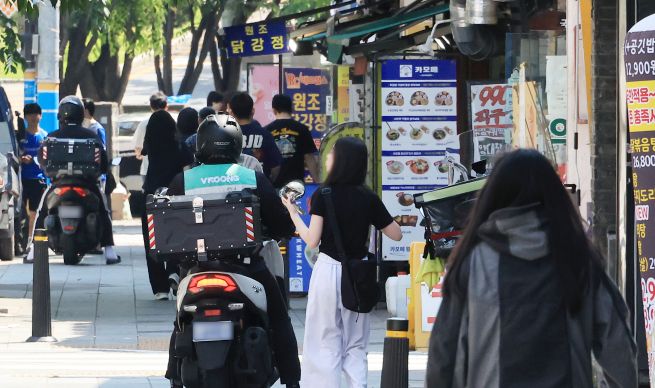
Delivery platform commissions and delivery fees are increasingly burdening small business owners. On May 25, a delivery rider prepares for a pickup in front of a restaurant in Seoul. (Yonhap)
SEOUL, March 27 (Korea Bizwire) — On weekends, 55-year-old Jang Mo clocks into a small dessert café in Seoul not for a paycheck, but for family. She spends 12 hours a day pulling espresso shots, washing dishes, and scrubbing floors—all to support her daughter’s dream of running a successful bakery.
But dreams, Jang has learned, don’t pay the bills.
“Even if we sell a coffee and dessert set for 15,000 won, the platform takes about 5,000 just for delivery and fees,” she says, shaking her head. “Add in ingredients, rent, electricity—what’s left?”
Jang’s daughter opened the café five years ago, just as the COVID-19 pandemic brought foot traffic to a halt. They leaned into delivery apps, riding the wave of Korea’s booming online ordering culture. It worked—at first. But as platform fees climbed and global inflation surged, the very systems that once sustained them are now sinking them.
When Delivery Becomes a Liability
On a recent order, a receipt showed a grim breakdown: from a 15,000-won sale, the café was left with just 10,193 won after the app deducted intermediary fees, VAT, and the merchant’s share of the delivery charge. That doesn’t include rising costs for flour, milk, and sugar—many of which are imported and priced in dollars, now steeply more expensive amid Korea’s high exchange rate.
“We trusted the delivery platforms to help us grow,” Jang says. “But now, they just eat into everything.”
Some apps offer cost-saving options, such as letting merchants handle delivery themselves through third-party couriers. But Jang suspects there’s a price to pay for that too. Since switching to an outside delivery service, the café’s listings were pushed to the bottom of the app. “It felt like punishment for not using their delivery,” she says.
Faced with dwindling profits, Jang’s daughter made a tough call: abandon the delivery-first strategy and relocate to a bigger space, one that could bring in more foot traffic. “Now, if we don’t have people coming into the store, we can’t survive,” Jang says.
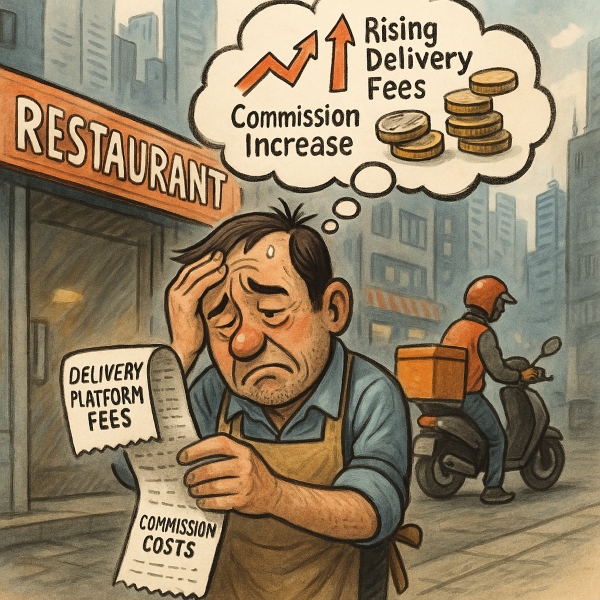
Korean Small Cafes Struggle Under Mounting Delivery Platform Fees and Inflation (Image supported by ChatGPT)
The Hidden Cost of Korea’s Platform Economy
Consumers may be ordering coffee and bread with the tap of an app, but the profits are vanishing before they reach the bakers. Delivery platforms don’t brew the drinks or bake the pastries, yet they extract a significant portion of the sale in exchange for visibility. Reviews are written by customers, often unpaid, while riders are typically gig workers operating as independent contractors.
What the platforms truly sell is “networking power”—a digital real estate that merchants feel forced to rent. Fees and discounts designed to lure customers often fall squarely on the shoulders of business owners, who absorb the cost to stay competitive in the app’s high-stakes marketplace.
Recognizing this imbalance, the South Korean government established a joint working group in 2024 that succeeded in introducing a tiered fee structure based on transaction volume. Still, small business forums and chat groups like “It Hurts to Be a Boss” remain flooded with posts decrying unsustainable delivery costs.
And the financial squeeze isn’t letting up. Processed food prices jumped 4.1% in April 2025—the steepest increase in 16 months—driven by the won’s continued weakness against the dollar. For café owners like Jang’s daughter, it’s a double blow: higher input costs and shrinking margins from every sale.
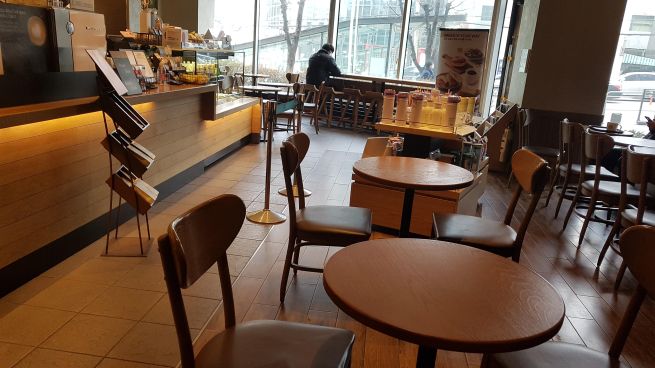
The interior of a coffee shop. (Yonhap)
Can You Quit Delivery? Not Easily
Despite the squeeze, walking away from delivery apps isn’t easy. In December 2024, Korea’s three major delivery platforms—Baemin, Coupang Eats, and Yogiyo—counted a combined 37.5 million monthly active users. That kind of visibility is hard to give up.
“Some days, when people say the bread is amazing, I feel like we can make it,” Jang says. “Other days, I wonder if I’d earn more just working part-time at another bakery.”
Public delivery platforms, pitched as an alternative to private-sector dominance, haven’t yet reached scale. In platform economies, market power compounds with network size—making latecomers inherently disadvantaged.
A Market in Retreat
According to government data, Korea’s café sector shrank in the first quarter of 2025—the first decline for the category since records began in 2018. Other staples of daily life, from Korean and Chinese restaurants to convenience stores and fast-food outlets, are seeing similar trends.
What’s more unusual is that this is happening after the pandemic. Unlike the lockdown years, when government subsidies and pent-up demand helped some businesses survive, today’s downturn is structural. High interest rates, lingering debt from the pandemic era, inflation, and trade tensions—exacerbated by protectionist U.S. policy—have converged into a perfect storm.
The economic logic is sobering: in a growing economy, food service businesses typically expand. A contraction—even in essential categories—signals distress far beyond individual cafés.
For Jang and her daughter, the math no longer adds up. But the hope, somehow, still lingers.
“We just want to make a living doing what we love,” Jang says, wiping flour from her hands. “But these days, love isn’t enough.”
M. H. Lee (mhlee@koreabizwire.com)