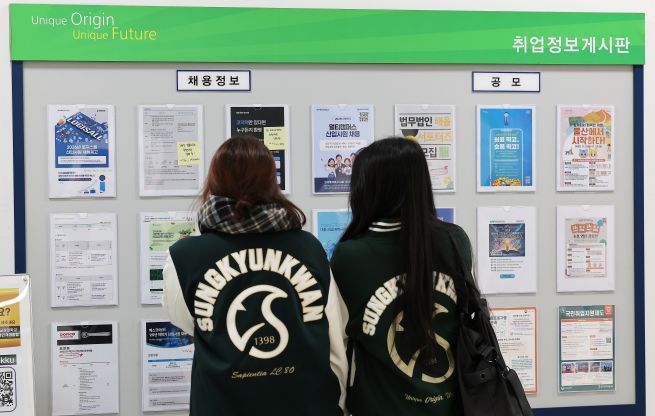
Students look at a job bulletin board at a university in Seoul. (Yonhap)
SEOUL, Jan. 19 (Korea Bizwire) — Young workers in South Korea are increasingly gravitating toward large corporations, even as employment at small businesses shrinks to historic lows — a widening divide that is reshaping the country’s labor market.
Government microdata from the Economically Active Population Survey show that in 2025, the number of people in their 20s and 30s employed at companies with 300 or more workers rose to a record 1.58 million, the highest level since comparable statistics were first compiled in 2014.
Nearly 60 percent of last year’s increase in large-company employment came from young workers, underscoring their growing concentration in major firms.
By contrast, youth employment at small and medium-sized enterprises fell to its lowest level on record. While total employment at smaller businesses continued to rise overall, the number of workers in their 20s and 30s dropped to 7.41 million, reflecting a steady decline that has persisted since 2022.
Economists say the trend is being driven by widening wage gaps and concerns over job stability. In 2023, workers at companies with more than 300 employees earned an average monthly income of 4.77 million won, more than 2 million won higher than those at firms with fewer than 50 workers.
Jobs Emerge as Top Factor Behind Falling Births and Regional Flight in South Korea (Image courtesy of Yonhap)
The disparity grows with tenure: while the pay gap for entry-level employees was relatively modest, it more than quadrupled for workers with over 20 years of experience.
Limited mobility between company sizes has further intensified young workers’ caution. Only about 12 percent of employees at small businesses successfully moved to large firms in 2023, making first-job decisions increasingly consequential.
At the same time, income has become a stronger factor in career choices. Surveys show that the share of people in their 20s who prioritize pay when selecting a job has risen sharply over the past decade, a trend mirrored among those in their 30s.
As a result, many young Koreans are choosing to wait rather than accept positions at smaller firms. The number of people in their 20s and 30s classified as “economically inactive due to rest” climbed to a record 717,000 last year — the highest since such data were first collected in 2003.
“The issue is no longer simply the number of jobs available,” said Yang Jun-seok, a professor of economics at Catholic University of Korea. “With such large gaps in wages and job security, young people naturally aim for large corporations. The real challenge lies in improving job quality and mobility across the labor market.”

Seoul’s downtown area, where major corporate headquarters are clustered. (Image courtesy of Yonhap)
Ashley Song (ashley@koreabizwire.com)