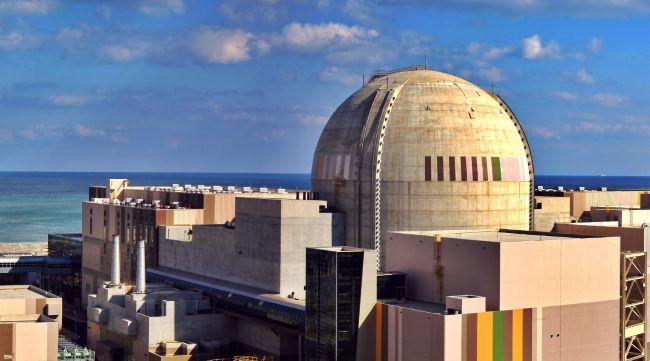
Shin-Wolsong Nuclear Power Plant Unit 2. (Image courtesy of Wolseong Nuclear Power Plant)
SEOUL, Aug. 15 (Korea Bizwire) — South Korea’s nuclear regulator has warned that rapidly warming seawater — used to cool reactors — could force as many as eight reactors offline within the next 10 years unless cooling capacity is improved.
At a meeting on August 14, the Nuclear Safety and Security Commission received a report from Korea Hydro & Nuclear Power (KHNP) outlining its response and future plans to counter the impact of climate change on seawater temperatures.
Reactors must keep containment building cooling water below 43.33 degrees Celsius in emergencies, which requires seawater intake to remain under plant-specific design limits — currently between 31°C and 36.1°C. Exceeding those limits triggers an automatic shutdown.
Last year, all Korean nuclear sites except Shin Hanul Units 1 and 2 recorded record-high seawater temperatures. The most vulnerable are Shin Wolsong Units 1 and 2, designed for 31.5°C but already seeing temperatures as high as 31°C; their margin could vanish in just six years.
The Hanbit complex on the warmer West Sea faces a similar risk within 7–10 years.
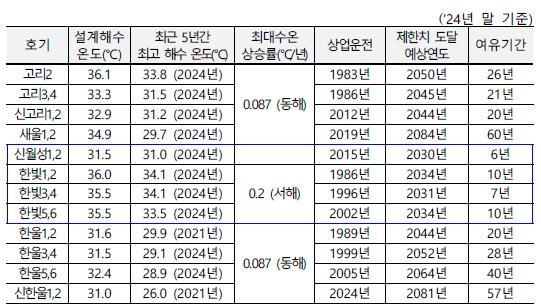
Design seawater temperature, maximum in past 5 years, and remaining margin by nuclear power plant. (Image courtesy of Nuclear Safety and Security Commission (NSSC))
Since 2001, KHNP has raised operational temperature limits six times by using built-in safety margins, but it now plans hardware upgrades to extend cooling capacity.
Shin Wolsong Units 1 and 2 will seek regulatory approval this month to boost their design seawater temperature by 1.37°C by adding heat-transfer plates to their heat exchangers. Hanbit Units 1–6 will complete similar upgrades by 2029.
KHNP will also establish a seawater temperature monitoring and forecasting system, assess reactor margins annually, and develop step-by-step protocols — from intensified inspections to shutdown — for high-temperature events.
Nuclear safety chief Choi Won-ho urged KHNP to move swiftly on upgrades to “fundamentally resolve” the risks and to ensure rapid response whenever unusually high seawater temperatures are recorded. The commission will conduct regular checks to ensure the improvements stay on track.
Kevin Lee (kevinlee@koreabizwire.com)