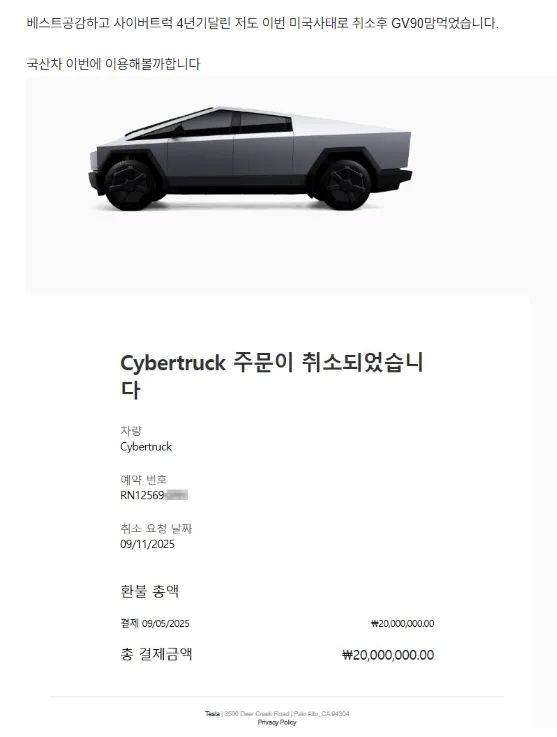
On September 11, as the departure of more than 300 South Koreans detained by U.S. immigration authorities was delayed, a post appeared on an online automobile forum showing proof of a canceled Tesla reservation. (Image source: Online community capture)
SEOUL, Sept. 11 (Korea Bizwire) — A wave of online calls to boycott American goods erupted in South Korea on Thursday after the U.S. delayed the repatriation of roughly 300 Korean workers detained in Georgia last week.
Posts on forums and social media targeted Costco, McDonald’s, and Starbucks, with some pledging to cancel Tesla orders or abandon subscriptions to Netflix and Apple Music.
“I canceled my Model Y contract right after I saw the detention news,” one consumer wrote in a car forum. “I was furious and had to show it somehow.”
The backlash follows the release of video footage by U.S. Immigration and Customs Enforcement showing workers at Hyundai and LG Energy Solution’s joint battery plant being shackled and loaded onto buses during a raid.
Many Koreans condemned the treatment, calling it demeaning for laborers who had traveled abroad to work.
While critics questioned whether such boycotts could have lasting economic effect, the rhetoric underscored a shift in sentiment, with some commentators urging Seoul to recalibrate ties and diversify away from reliance on Washington.
The flare-up mirrors past episodes abroad, where U.S. tariffs and trade disputes prompted consumer campaigns in Canada, India, and even Switzerland against American products.
President Lee Jae-myung, marking his 100th day in office, acknowledged the dispute stemmed from U.S. insistence on shackling the workers until they boarded flights, a demand Seoul resisted.
He said the transfer was delayed only after President Donald Trump intervened, ordering that the Koreans be allowed to return “freely.”
M. H. Lee (mhlee@koreabizwire.com)