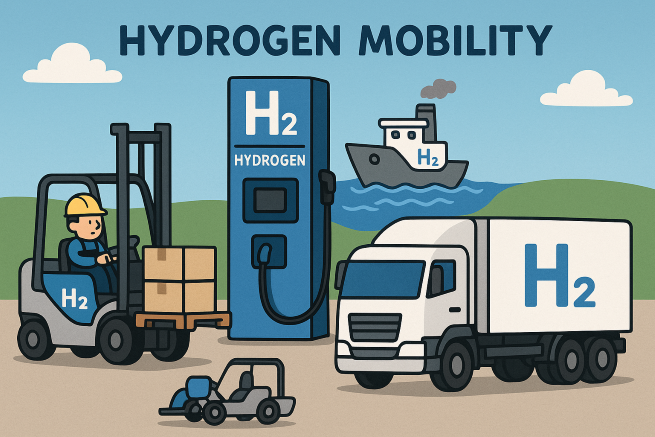
Hydrogen Mobility Market Set to Grow as South Korea Broadens Fueling Rules (Image supported by ChatGPT)
SEOUL, May 26 (Korea Bizwire) — South Korea has formally expanded the legal framework for hydrogen fuel usage beyond automobiles, paving the way for broader adoption of hydrogen-powered mobility technologies across diverse sectors including logistics and maritime transportation.
The Ministry of SMEs and Startups and the city of Ulsan announced on Sunday that the regulatory sandbox program under the Ulsan Hydrogen Green Mobility Free Regulatory Zone has successfully completed pilot testing for the operation and refueling of hydrogen mobility equipment such as forklifts, unmanned transport vehicles, and hydrogen-fueled ships.
Until recently, South Korean law permitted hydrogen refueling only for automobiles, effectively stalling the development and deployment of hydrogen mobility solutions for other sectors. In response, the Ulsan regulatory zone—established in December 2019—undertook multi-year trials to demonstrate the viability and safety of hydrogen use in non-automotive vehicles.
As a result of these efforts, the government amended the Enforcement Rules of the High-Pressure Gas Safety Control Act in November 2024. The revision, which took effect earlier this month, now allows hydrogen refueling for a wider range of mobility devices, including industrial and maritime equipment.
Officials expect the regulatory changes to accelerate commercialization of hydrogen mobility technologies, invigorate the domestic hydrogen industry, and position South Korea more competitively in the global market.
Since its designation, the Ulsan zone has attracted 44.7 billion won (approximately $32.9 million) in investments and welcomed 13 companies into the special zone. It has also produced 46 intellectual property filings, including 10 registered patents, further strengthening the city’s hydrogen ecosystem.
“This regulatory breakthrough enables safe and legal hydrogen refueling for non-automotive mobility, laying a critical foundation for a broader hydrogen economy,” said Lee Gui-hyun, Director of the Special Regulatory Zone Innovation Planning Division at the Ministry. “We expect this will stimulate industrial growth and accelerate Korea’s transition toward a hydrogen-powered future.”
M. H. Lee (mhlee@koreabizwire.com)