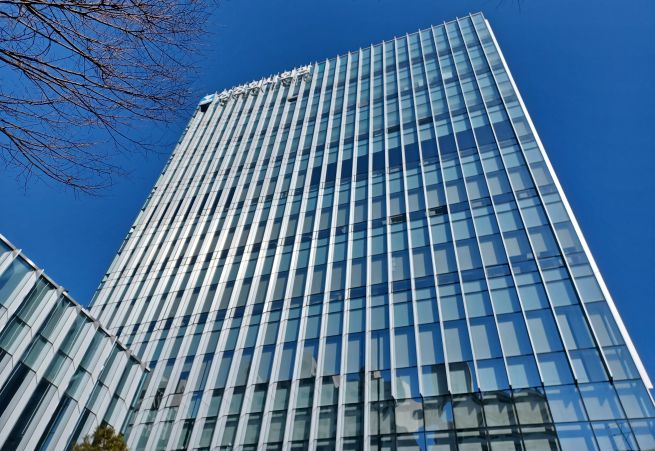
The exterior view of the Korea Listed Companies Association building. (Image courtesy of Yonhap)
SEOUL, Oct. 2 (Korea Bizwire) — South Korea’s leading association of listed firms has voiced opposition to a proposed across-the-board corporate tax hike, arguing it would further burden businesses already struggling with weak global demand and a downturn in the semiconductor sector.
The Korea Listed Companies Association (KLCA) said Tuesday it had submitted a formal opinion to the National Assembly’s Strategy and Finance Committee and the Ministry of Economy and Finance opposing amendments introduced by Democratic Party lawmakers Kim Ki-pyo and Ahn Do-geol.
The proposals, aligned with the government’s July tax reform blueprint, call for raising corporate tax rates by one percentage point across all income brackets, lifting the top rate for earnings above 300 billion won ($217 million) from 24 percent to 25 percent.
Currently, corporate tax is levied progressively, ranging from 9 percent for taxable income below 200 million won to 24 percent for earnings above 3 billion won.
The KLCA argued that shrinking corporate tax revenue is driven not by the recent rate cuts but by worsening external conditions and falling profits in key industries.
It also noted that Korea’s top marginal corporate tax rate already exceeds the OECD average by more than five percentage points, warning that further hikes run counter to a global trend toward tax reductions.
Instead, the association backed a rival bill from Rep. Choi Eun-seok of the ruling People Power Party that would lower the top corporate rate from 24 percent to 20 percent.
The KLCA also weighed in on several other legislative proposals. It opposed a capital markets bill from Democratic Party lawmaker Min Hyung-bae that would force companies to reclaim short-swing profits from executives or major shareholders in all cases, arguing the rule would impose unnecessary costs even for negligible gains, citing a case where an insider transaction yielded only 842 won.
At the same time, the association supported Democratic lawmaker Kim Nam-geun’s bill to strengthen oversight of private equity-led leveraged buyouts, saying it could reduce risks for stakeholders across the real economy.
It also backed proposals from ruling party lawmakers to lower Korea’s inheritance tax ceiling, including surcharges, from 60 percent to below 30 percent.
M. H. Lee (mhlee@koreabizwire.com)